
What ‘Local’ Actually Looks Like
What’s possible, what isn’t, and what gets eaten anyway.

Where I live, “local” is not a postcard. It’s not a linen bag of vegetables balanced on a vintage bicycle, or a Saturday morning spent drifting between stalls with a flat white in hand. It is messier than that. More provisional. Shaped by time, money, weather, and fatigue.
Local, for me, is a patchwork.
There is a farm shop minutes away that sells beef from cattle I have seen standing in the rain, backs to the downpour, tails flicking. The meat is excellent. It is also expensive enough that it’s not something I buy casually. When I do, it is planned for — stretched across meals, frozen in portions or served pride of place. Choices that acknowledge both value and restraint.
There are high quality eggs from a local small business that I love to support. Sometimes the vending machine is empty. Sometimes I just can’t deal with another stop on the way home after work. So maybe we have a different breakfast. Local requires flexibility. You learn to accept absence.
Vegetables are more complicated. In summer, local is generous: courgettes that arrive in threes whether you want them or not, lettuces with grit still in their folds, tomatoes that split if you look at them too hard. In winter, local narrows. Roots and brassicas dominate, and even then only if you are willing to cook them again and again. There can be weeks when the local offer feels like a test of imagination rather than a pleasure.
So sometimes I buy oranges. Sometimes I buy rice. Sometimes I buy olive oil without apology. I do not grow wheat. I do not press oil. Local has edges, for me, and pretending otherwise helps no one.
There is a butcher in the nearby town who knows his suppliers and will tell you, plainly, when something isn’t British. He does not pretend everything is perfect. He does not call imported lamb “local-adjacent”. He just says, “This is the best option I have today.” That honesty matters more to me than purity.
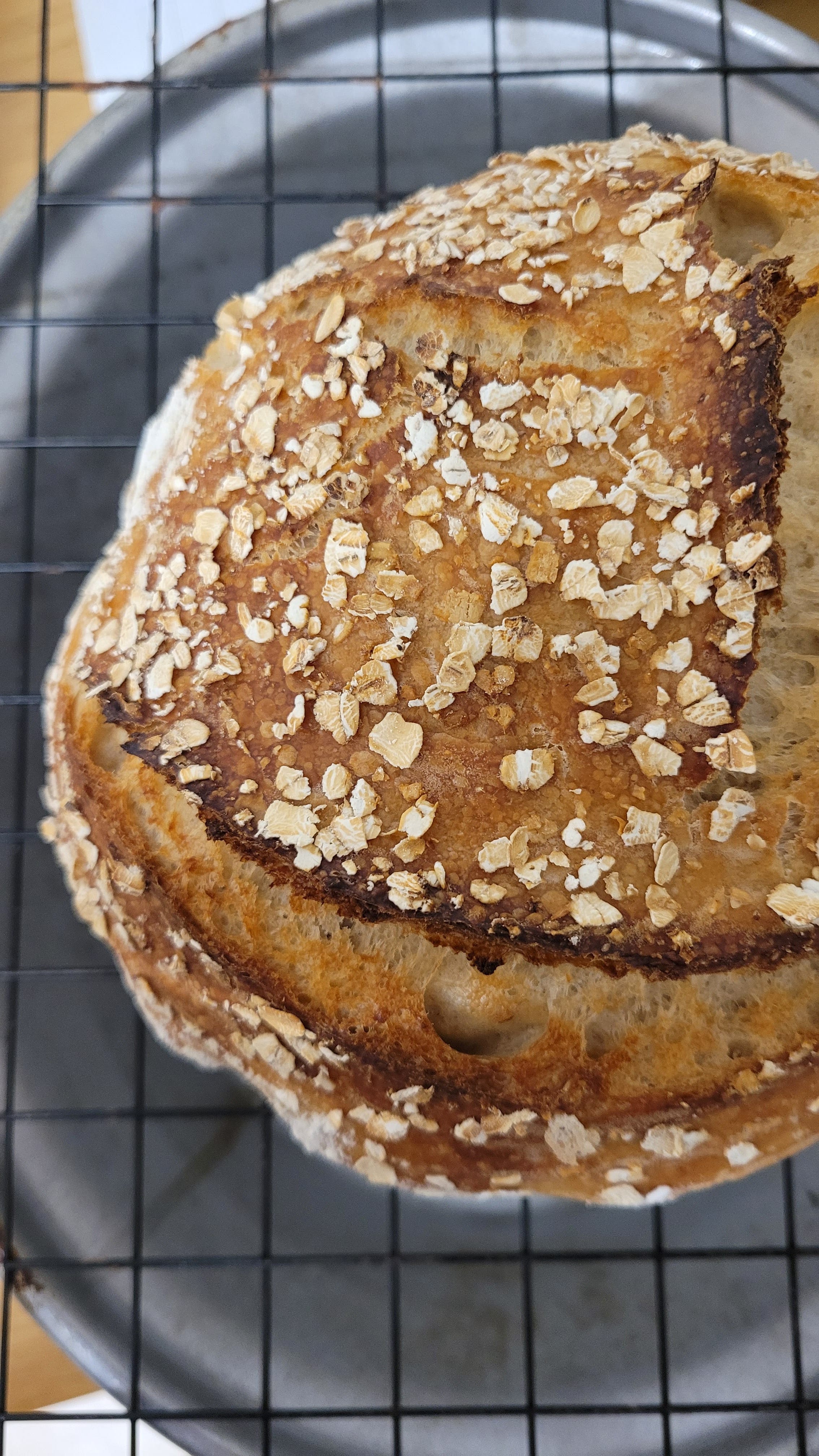
Bread comes from my own oven if I have time, or a small bakery on days when I pass it. On other days, it comes from the supermarket. The local loaf is better, yes — flavour, crumb, crust, principle — but it also requires planning and a margin of time that is not always available. Local often assumes leisure. Real life does not always oblige.
Cheese, when I can afford it, comes from producers whose names I recognise. I think it tastes better, and I cherish every crumb. When I cannot afford it, I buy what is on offer and eat it with pleasure anyway. Shame has no nutritional value.
What local does not look like is consistency. It shifts week to week, month to month. It depends on cash flow, on energy, on whether I have remembered to defrost something. It depends on whether I am feeling resilient or threadbare.
There are compromises that feel acceptable and others that chafe. I am comfortable buying British meat and imported pulses. I am less comfortable when price pushes me towards food that has been squeezed thin by the system — when value has been extracted from land, labour, or animal welfare to make something artificially cheap. But even then, judgement is useless. Fed is best; people need to eat within the constraints they have.
Local will also look different depending on who you are feeding. Cooking for yourself or for two allows a level of negotiation and experimentation that disappears when you are responsible for others. Nutrition, satiety, familiarity — these matter. A food system that ignores them in favour of ideals is brittle.
From a health perspective, there is nothing inherently virtuous about local food, just as there is nothing inherently harmful about imported food. What matters is adequacy, balance, and reliability. The quiet strength of local systems is not that they are morally superior, but that they shorten the distance between cause and effect. You see the field. You taste the season. You notice when something is strained.
And perhaps that is the truest thing local offers where I live: not perfection, but proximity. To weather. To limits. To the reality that food is grown by people who are not insulated from cost rises, policy shifts, or bad harvests.
Local, here, is not a badge. It is a series of choices made with varying degrees of intention. Some weeks it is thoughtful and aligned. Other weeks it is pragmatic and tired. Both are real.
If there is a principle beneath it all, it is this: eating in a way that keeps you connected — to place, to people, to your own capacity — is more sustainable than chasing an ideal you cannot maintain.
Local, as it exists in my life, is not something to defend. It simply is. And that, I think, is enough.
👏 Steph
Brilliant and perfectly said! As a small-scale farmer and baker, local is my livelihood. But I also have limits (financial, time, attention) and so I prioritize. I live in a country that produces everything but coffee (although with climate change I think we could grow that too) and so sometimes "local" is simply from my province or my country. And that is ok. Thank you for writing this.